





NewsFlash | Warrior Care
Warrior Care
 Warrior Care – The Department of Defense (DoD) and the United States Department of Veterans Affairs (VA) reaffirms its commitment that there is no higher priority than caring for the wounded, ill, and injured Service members who have sacrificed so much. The mission is to proactively support wounded, ill, and injured Service members in their recovery and reintegration or transition to civilian life. Warrior Care honors the opportunity to provide assistance to spouses and dependents of Veterans who honorably served in our Nation's armed forces. The courage, strength, resilience, and commitment shown by DoD wounded warriors and the loved ones who support them is unmatched and inspiring. DoD, VA, Federal, private, and nonprofit organizations, works diligently to ensure that our wounded, ill, and injured Service members receive proper care and support. Our Service members exhibit tremendous strength through recovery, rehabilitation, and reintegration to their units or transition to civilian communities. This strength is represented in the physical, mental, spiritual, emotional, familial, and career-readiness activities that Service members and their families and caregivers engage in to overcome challenges. It is also evident in the commitment that DoD and VA reaffirms daily: to provide our wounded, ill, and injured Service members and their families and caregivers with the care and support they deserve. Warrior care encompasses a full spectrum of support through recovery, rehabilitation, and reintegration back to duty or transition into the community. The DoD Warrior Care Recovery Coordination Program and military services’ Wounded Warrior Programs provide comprehensive resources to assist recovering Service members and support spouses, families, and caregivers to meet their needs and achieve their goals.

United Services Organization (USO) – Since 1941, the USO has been the nation’s leading organization to serve the men and women in the U.S. military, and their families, throughout their time in uniform. From the moment they join, through their assignments and deployments, and as they transition back to their communities, the USO is always by their side. Today’s USO continuously adapts to the needs of our men and women in uniform and their families, so they can focus on their very important mission. USO airport centers throughout the country offer around-the clock hospitality for traveling Service members and their families. USO tours bring America and its celebrities to service members who are assigned far from home, to entertain them and convey the support of the nation. And our many specialized programs offer a continuum of support to service members throughout their journey of service, from the first time they don the uniform until the last time they take it off. The USO is not part of the federal government. A congressionally chartered, private organization, the USO relies on the generosity of individuals, organizations and corporations to support its activities, and is powered by a family of volunteers to accomplish our mission of connection. As a 501(c)(3) nonprofit organization, the USO has relied on the generosity of corporations and foundations for more than 70 years. Corporate support through sponsorship, cause-marketing initiatives, in-kind and philanthropic donations is vital to advancing the mission of the USO. Contact the USO by phone with your questions at 1-888-484-3876.
Veterans Service Organization (VSO) and VA accredited representatives – Need help? Appoint a Veteran Service Organization (VSO), attorney, or claims agent to assist you. In most cases, it is not necessary for Veterans to get assistance from an attorney. However, many Veterans choose to get free assistance from organizations such as the Disabled American Veterans (DAV), Veterans of Foreign Wars (VFW), and the Military Order of the Purple Heart (MOPH). These organizations will typically ask you to sign a limited power of attorney, which will allow them to speak with the VA on your behalf. They can help you determine status, ask the VA to reconsider the severity of your rated ailments, and help you with other support actions. Use VA search tools to find accredited representatives to help you.
Veterans of Foreign Wars (VFW) – VFW is the largest and oldest war Veterans Service Organization, offering free Veteran and military family support programs and services. Veteran qualification for membership in the VFW must meet two requirements:
- Honorable Service – must have served in the Armed Forces of the United States and either received a discharge of Honorable or General (Under Honorable Conditions) or be currently serving.
- Service in a war, campaign, or expedition on foreign soil or in hostile waters. This can be proven by any of the following:
 An authorized campaign medal Receipt of Hostile Fire Pay or Imminent Danger Pay Service in Korea for 30 consecutive or 60 non-consecutive days qualify.
This information is usually available through a veteran’s DD-214. If other information is needed or if a veteran’s DD-214 is not complete, they can contact the National Personnel Records Center. VFW Accredited Service Officers are trained experts, helping Veterans develop their case with ease by reviewing and applying current law, pertinent legislation, regulations and medical histories. As skilled professionals, VFW assists in filing for disability compensation, rehabilitation and education programs, pension and death benefits, and employment and training programs. Furthermore, VFW won’t hesitate to request hearings before the VA and the Board of Veterans Appeals to present oral arguments when needed. VFW Accredited Service Officers are with America's veterans every step of the way once they're ready to file a claim. VFW Pre-Discharge representatives guide military personnel through the VA claims process and can assist with the preparation and submission of forms and evidence to VA prior to separation from active duty. They can also answer questions about VA benefits and entitlements. VFW Pre-Discharge offices are located on or near major military installations across the country. If you are within 180 days of discharge, you can contact a VFW Pre-Discharge representative to get the process underway.
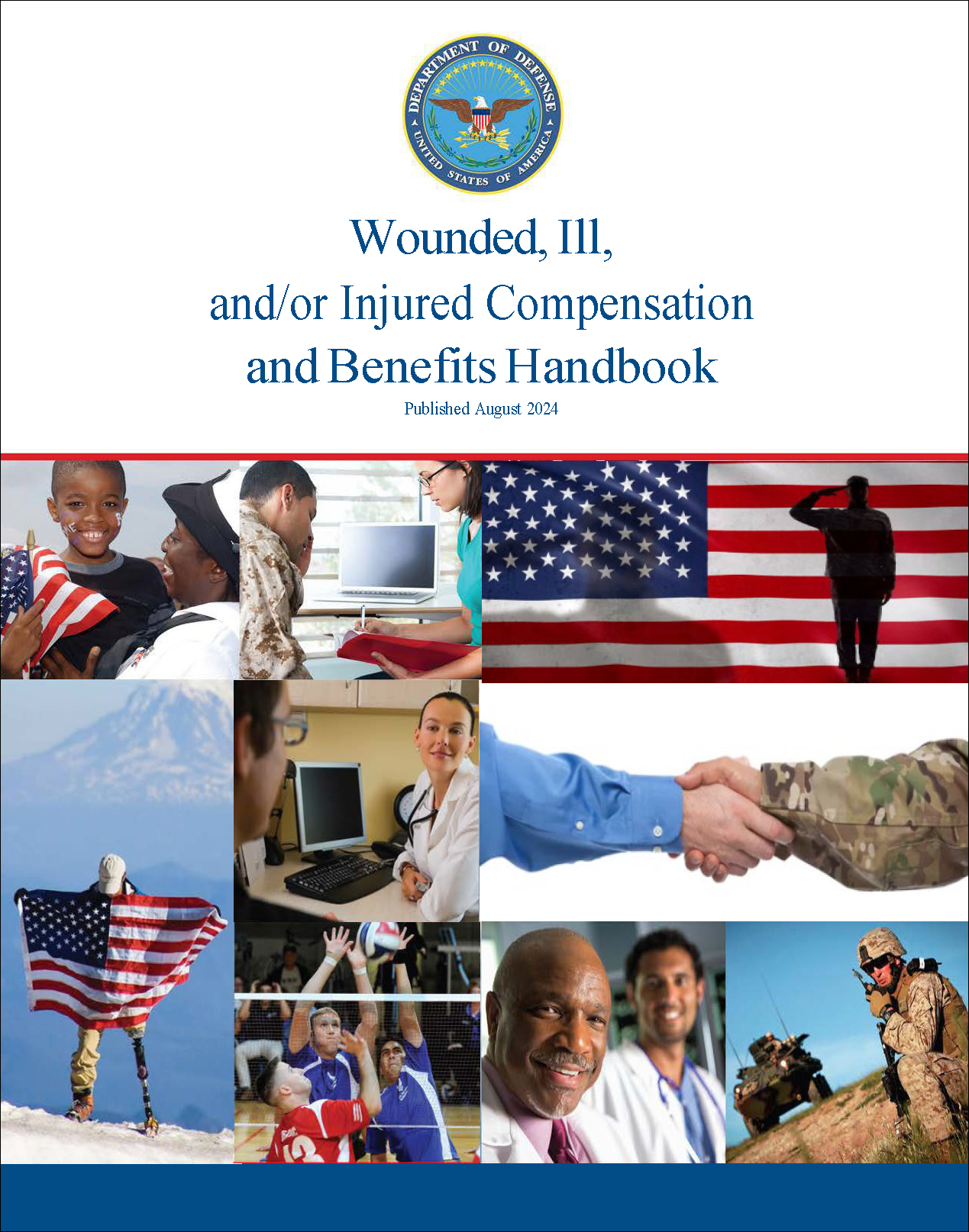
Wounded, Ill, and Injured Compensation and Benefits Handbook – Updated annually by the DoD in collaboration with VA, U.S. Department of Labor (DoL), U.S. Department of Education (ED), the U.S. Social Security Administration (SSA), and the U.S. Military Services. On active duty, most of your benefits come from the DoD. After you leave active duty, whether discharged or medically retired, you become eligible for a number of additional benefits from VA. To augment what’s in this handbook, we recommend that Service members contact their respective Service's Wounded Warrior Program with further questions, especially regarding Service-specific information regarding compensation and benefits. The wounded, ill, and injured population is broad, and includes not just the visibly wounded or injured. Many of the Service members going through recovery are suffering through a serious illness or dealing with post-traumatic stress or traumatic brain injury. Adaptive sports and reconditioning activities help wound warriors develop and enhance their skills in multiple domains of wellness, which can transfer to the job market and lead to success in other areas of life. It is important for wounded warriors to know that they are not alone; there is a community that supports them in their challenges and recognizes their success. Building connections, sharing resources, and finding strength together helps wounded warriors understand that they aren’t alone. Wounded warrior support programs seek to build connections within the community to lessen the sense of isolation often felt by those members.
U.S. Army Recovery Care Program (ARCP) – The U.S. Army Recovery Care Program (ARCP) manages recovery and complex care for wounded, ill, and injured Soldiers across all army components. Through the use of Soldier Recovery Units (SRUs), the ARCP manages the recovery of wounded, ill, and injured Soldiers through a comprehensive program of medical care, rehabilitation, professional development, and achievement of personal goals. When a Soldier enters the program, they work with a dedicated team of professionals at the SRU to assess their needs and establish goals for recovery. SRUs consist of a Headquarters platoon and three primary platoons: Complex Care, Veteran Track and Return to Duty. Each platoon tailors resources to fit the recovery needs and career goals of the individual Soldier. There are 14 SRUs located on military installations across the country. The program also provides resources and advocacy for families and caregivers of Soldiers recovering in the program. The Veteran Track platoon focuses on career and education readiness and provides resources that prepare Soldiers for a transition to Veteran status. ARCP partners with the U.S. Department of Veterans Affairs to ensure Soldiers have immediate access to all VA benefits and healthcare programs once they enter Veteran status. To learn more about enrollment, contact Army Recovery Program at 1-800-984-8523 or email us.army.ncr.hqda-otsg.mbx.arcp-contact-center1@health.mil.
U.S. Marine Corps Wounded Warrior Regiment (WWR) – The U.S. Marine Corps approaches each individual Marine and Sailor's recovery as a relationship, not a process, and encourages healing in all aspects of life. The Wounded Warrior Regiment (WWR) provides leadership, guidance, and ensures compliance with laws and DoD regulations related to the support, recovery, and non-medical care of combat and non-combat wounded, ill, and injured Marines, Sailors attached to Marine units, and their family members in order to maximize their recovery as they return to duty or transition to civilian life. To learn more about enrollment, contact Marine Corps Wounded Warrior Regiment at 1-877-487-6299 or online at www.woundedwarrior.marines.mil.

U.S. Navy Wounded Warrior (NWW) Safe Harbor – The U.S. Navy’s sole organization for coordinating the non-medical care of wounded, ill, and injured Sailors and Coast Guardsmen, and providing resources and support to their families. The formal Navy definition of a “wounded warrior” is any Sailor or Coast Guardsman who has a serious illness or injury requiring long-term care that may necessitate a Medical Evaluation Board/Physical Evaluation Board (MEB/PEB) to determine fitness for duty. Navy Wounded Warrior is not limited to those with combat-related injuries. It also encompasses Sailors and Coast Guardsmen with serious non-combat injuries, whether sustained on liberty or duty, as well as those suffering from significant physical or psychological illnesses such as cancer, MS, PTSD, and TBI. Participation in the program is voluntary, and Sailors and Coast Guardsmen must be enrolled to access the services. Referrals can come from various sources, including: Service Member's command, Peers, Medical staff, Fleet and Family Support Center personnel, Family members, and Self-referrals. NWW offers individualized and proactive guidance on non-medical care, including: Pay and benefits, Caregiver resources and respite care, Bedside travel, Job training, Childcare, and Adaptive reconditioning. The personalized Comprehensive Recovery Plan is an essential part of the continuum of care and enables Sailors and Coast Guardsmen. Since 2009, Navy Safe Harbor Foundation (NSHF) has been the NWWs first call when a Navy or Coast Guard Sailor is in need. To learn more about enrollment, contact NWW at 1-855-NAVY-WWP (1-855-628-9997) or email navywoundedwarrior.fct@navy.mil.
U.S. Air Force Wounded Warrior Program (AFW2) – AFW2 is a Congressionally-mandated and Federally-funded organization tasked with taking care of U.S. Air Force wounded, ill, and injured Airmen, U.S. Space Force Guardians, Veterans, and their families. Providing personalized restorative care throughout their transformation back to duty, separation, or retirement, staying in contact with them throughout the process as an Airman For Life. The AFW2 Recovery Care Program manages recovery and complex care for wounded, ill, and injuredAirmen and their caregivers/families across all components. To learn more about enrollment, contact AFW2 at 1-800-581-9437 or email afpc.dpfws.wiicell@us.af.mil.
 U.S. Special Operations Command (USSOCOM) Warrior Care Program - Care Coalition (WCP-CC) – The USSOCOM WCP-CC was established in 2005 to provide Special Operations Forces (SOF) wounded, ill, and injured Service members and their families advocacy after life changing events in order to navigate through recovery, rehabilitation, and reintegration as quickly as possible, strengthening SOF readiness. The primary goal is to assist SOF wounded, ill, and injured in getting back to duty, operationally fit and mentally prepared. To learn more about enrollment, contact USSOCOM WCP-CC at 1-877-672-3039 or email ussocomcarecoalition@socom.mil.
U.S. Flag – Flying the U.S. flag is appropriate every day. The U.S. and State flag should also be displayed on all National and State holidays, including historic and special occasions. Remember it is customary to display the flag only from sunrise to sunset. The U.S. and State flag may be displayed twenty-four hours with proper illumination. Use and display of the U.S. flag by civilians, civilian groups, and organizations are governed by 36 USC 173. Civilians who inquire about the display of the U.S. flag should be referred to this statute. The customary days to display the flag according to the Veterans of Foreign Wars (VFW) and the U.S. Army are provided on the NewsFlash U.S. Flag and Holidays section. Learn about Half-Staff, Military Funeral Honors, Burial Flag, Order of Precedence, and Use and Display by Civilians. Flag request information for the Navy Memorial, Air Force Memorial, Capitol Hill, Pentagon, and many military bases and ships is also provided.
American Former Prisoners of War – You are considered a Former Prisoners of War (FPOW) if during wartime active service, you were forcibly detained or interned (put in prison) in the line of duty by an enemy government, its agents or a hostile force. You are considered a FPOW if you were forcibly detained or interned by a foreign government or its agents or a hostile force during peacetime active service, if the circumstances of the internment were comparable to wartime internment. For example: Iran, Somalia, or Kosovo.
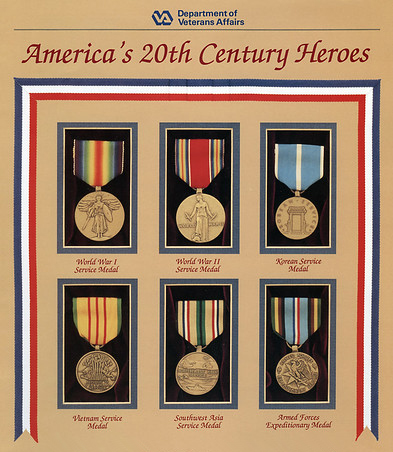 World War II Veterans – World War II (WWII) was the most widespread war in history with more than 100 million people serving in military units. About 16 million Americans served during WWII, and many of those Veterans are now receiving VA benefits including Pension and Health Care. WWII Veterans who were a part of the Occupation Forces assigned to Hiroshima and Nagasaki, Japan soon after the detonation of Atomic-Bombs over those respective cities, and those American prisoners of war ( POW's ) who were housed in close proximity to those cities are sometimes called "Atomic Veterans."
Korean War Veterans – Approximately 5.7 million Veterans served in the Korean War. Korean War Veterans are more prone to suffer from disabilities related to cold injures as a result of exposure to severe cold climates. Cold weather accounted for 16% of Army non-battle injuries and over 5,000 U.S. casualties of cold injury required evacuation from Korea during the winter of 1950-1951. In many instances, Servicemembers could not seek or were unable to obtain medical care for cold injuries because of battlefield conditions.
Vietnam War Veterans – United States military involvement in the Vietnam War officially began on August 5, 1964; however, the first U.S. casualty in Vietnam occurred on July 8, 1959. Approximately 2.7 million American men and women served in Vietnam. During the war, over 58,000 U.S. military members lost their lives and 153,000 were wounded. There were 766 prisoners of war of which 114 died in captivity. The war was officially ended by Presidential Proclamation on May 7, 1975.
Gulf War Veterans – More than 650,000 Service members served in Operation Desert Shield and Desert Storm from August 2, 1990 to July 31, 1991. For VA benefits eligibility purposes, the Gulf War period is still in effect. This means that anyone who served on active duty from August 2, 1990, to present is considered a Gulf War Veteran. For example, the Veterans Pension benefit requires service during a wartime period. Therefore, any Veteran who served on active military service for any period from August 2, 1990, to the present meets the wartime service requirement.
VA Community Care Network (MISSION ACT) – Since 2019, the MISSION Act has enabled VA-enrolled Veterans to access health care from non-VA providers at the department’s expense when it is in their best medical interest. These decisions have been made jointly by Veterans and their referring clinicians but were not considered final until they were reviewed by a second VA doctor. In May 2025, VA implemented the Senator Elizabeth Dole 21st Century Veterans Healthcare and Benefits Improvement Act and streamlined the process for determining best medical interest. The MISSION Act provides eligible Veterans the option of seeking community care outside VA when they meet any one of six conditions:
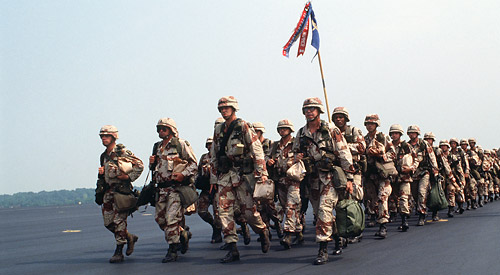 When it is in the best medical interest of the Veteran.
- The care required is not available at a VA medical facility.
- The Veteran lives in a state or territory that does not have a full-service VA facility
- VA cannot meet wait time or distance standards:
- VA cannot offer an appointment within 20 days for primary care, mental health or non-institutional extended care, or within 28 days for specialty care.
- It takes more than a 30-minute drive to reach primary or mental health care, or a 60-minute drive for specialty care.
- VA service does not meet certain quality standards.
- The Veteran meets the grandfathered distance and location provisions of the former Veterans Choice Program.
Types of care under VA Veterans Community Care include General Community Care, Urgent Care, Emergency Care, Foreign Medical Care, Home Health and Hospice Care, Indian and Tribal Health Services, In Vitro Fertilization, State Veterans Home, and Flu Shots. During a medical emergency, Veterans should immediately seek care at the nearest medical facility. Generally, emergency treatment is only covered until such time as the Veteran can be safely transferred to a VA or other federal facility. If the Veteran refuses to be transferred to a VA or other federal facility after their emergency condition is stabilized, they may be liable for the cost of care beyond the point of stabilization.
SPACE A Travel – When congress signed the John S. McCain National Defense Authorization Act, 100% service connected disabled Veterans became eligible for Space Available Travel. Better known as ‘Space-A’ or military hops, Air Mobility Command (AMC) maintains an extensive network of flights throughout the continental United States, Alaska, Hawaii, Puerto Rico, the U.S. Virgin Islands, Guam and American Samoa. Supplementing this network, several Air National Guard and Naval Aviation Units have flights available. To be eligible for Space-A flights, Veterans must have a permanent and total service-connected disability rating. These Vets must also obtain a DD Form 2765, “Department of Defense/Uniformed Services Identification and Privilege Card (TAN). The Space-A Program fills surplus capacity and seating on DOD aircraft. A popular perk among retirees, now eligible Veterans can take advantage of the program and fly for free. So, whether the Veteran is looking for a getaway to Hawaii or a trip to catch-up with their Veteran brothers and sisters on the other side of the country, the Space-A travel program can fly you there. For more information including: eligibility, locations, schedules, baggage, contact info, and; to register for the Space-Available Travel Email Sign-Up visit the Air Mobility Command—Space Available Travel Page.
 American Forces Travel – The U.S. Department of Defense official online leisure travel site for active military, Guard or Reserve, U.S. Coast Guard, Retired military, and all eligible MWR patrons. In addition to flights, American Forces Travel offers event tickets, vacation packages, cruises, rental cars, and hotels. Access to AmericanForcesTravel.com discounts are strictly limited to those who are verified as MWR eligible. American Forces Travel is committed to providing high-quality and best value travel services to patrons affiliated with the Department of Defense as a way to thank them for their service and dedication to our country. Authorized Patrons:
- All current active duty military (Army, Marine Corps, Navy, Air Force, and Coast Guard)
- All members of the Reserve components and National Guard
- Coast Guard Auxiliary Active Duty
- All current active duty and retired National Oceanic and Atmospheric Administration (NOAA)
- All current active duty and retired US Public Health Service (USPHS)
- All retired military, including those in the Reserves and National Guard who are retirement eligible
- All Medal of Honor recipients
- All Veterans with service-connected disabilities, all Veterans who are Purple Heart recipients, all Veterans who are former prisoners of war, all individuals approved and designated as the primary family caregivers of eligible Veterans under the Department of Veterans Affairs Program of Comprehensive Assistance for Family Caregivers.
- Eligible family members who are officially sponsored (ID card holder) by authorized patrons in the above categories
- All Department of Defense and Coast Guard civilians, including appropriated funds employees and non-appropriated funds employees
- Full-time, paid employees of the American Red Cross and United Service Organizations (USO) hired in the United States and serving at U.S. DoD installations overseas
- All Veterans of the United States Armed Forces with a discharge status of honorable or general under honorable conditions.
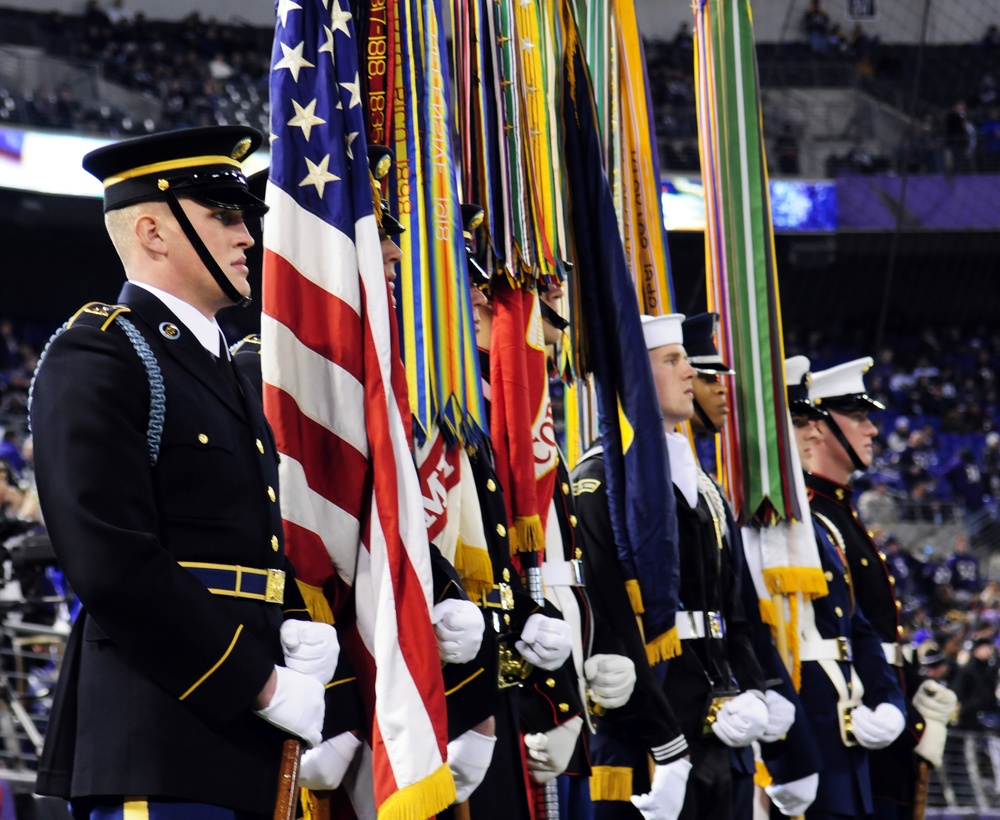 Veterans Health Administration (VHA) – VHA continues to meet Veterans' changing medical, surgical and quality-of-life needs. Veterans can complete applications for enrollment in VA health care. VA Liaisons are nurses and social workers who coordinate the transfer of health care from DoD to VA for service members as they exit the military. VA Liaisons connect Veterans with the Post-9/11 Military2VA team at your selected VA facility. Located at DoD installations, VA Liaisons coordinate health care needs from the military treatment facility (MTF) to a VA health care facility. Once enrolled, Veterans can receive health care at VA health care facilities anywhere in the country. Veterans who served in a theater of combat operations also have special eligibility for VA health care. Under the "Combat Veteran" authority VA provides cost-free health care services and nursing home care for conditions possibly related to military service and enrollment in Priority Group 6 or higher for 5 years from the date of release from active duty, unless eligible for enrollment in a higher priority group. Combat Veterans who enroll with VA under this enhanced Combat Veteran authority will continue to be enrolled even after their enhanced eligibility period ends, although they may be shifted to Priority Group 7 or 8, depending on their income level, and required to make applicable copays. Additionally, for care not related to combat service, copays may be required depending on their financial assessment and other special eligibility factors.
Priority Groups: During enrollment, each Veteran is assigned to a priority group. VA uses priority groups to balance the demand for VA health care enrollment with resources. Changes in available resources may reduce the number of priority groups VA can enroll. If this occurs, VA will publicize the changes and notify affected enrollees.
Group 1: Veterans with service-connected disabilities rated 50% or more; Veterans determined by VA to be unemployable due
to service-connected conditions; and Veterans who have been awarded the Medal of Honor.
Group 2: Veterans with service-connected disabilities rated 30 or 40%.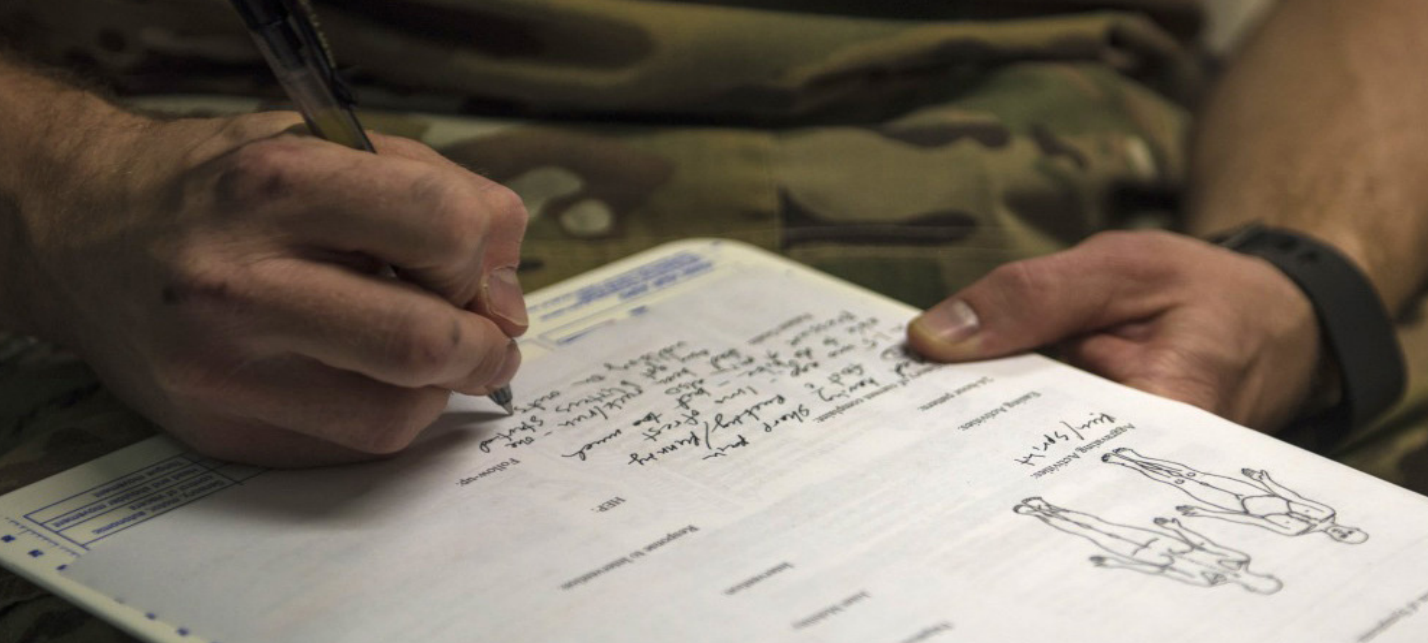 Group 3: Veterans who are former prisoners of war (POW); Veterans awarded the Purple Heart medal; Veterans whose discharge was for a disability incurred or aggravated in the line of duty; Veterans with VA service-connected disabilities rated by VA at 10 or 20%; Veterans whose disability compensation is suspended because of the receipt of military retired pay; Veterans receiving compensation at the 10% rate based on multiple non-compensable service-connected disabilities that clearly interfere with normal employability; and Veterans awarded special eligibility classification under Title 38, U.S.C., § 1151, “benefits for individuals disabled by treatment or vocational rehabilitation.”
Group 4: Veterans who receive increased compensation or pension based on their need for regular aid and attendance or by reason of being permanently housebound and Veterans determined by VA to be catastrophically disabled.
Group 5: Nonservice-connected Veterans and non- compensable service-connected Veterans rated by VA as 0% disabled and who have an annual income below the VA’s geographically adjusted income limit (based on Veteran’s ZIP code); Veterans receiving VA Pension benefits; and Veterans eligible for Medicaid benefits.
Group 6: Compensable 0% service-connected Veterans; Veterans exposed to ionizing radiation during atmospheric testing or during the occupation of Hiroshima and Nagasaki; Project 112/SHAD participants; World War II (WW II) Veterans; Veterans who served in the Republic of Vietnam between January 9, 1962, and May 7, 1975; toxic exposed Veterans who served in specific locations during certain periods; Veterans who served in the Southwest Asia theater of operations from August 2, 1990, through November 11, 1998; and Veterans who served in a theater of combat operations after November 11, 1998, as follows: Veterans discharged from active duty on or after September 11, 2001, for ten years post discharge; and Veterans who served on active duty at Marine Corps Base Camp Lejeune, N.C. for at least 30 days between August 1, 1953 and December 31, 1987. Currently enrolled Veterans and new enrollees who served in a theater of combat operations after November 11, 1998, and those who were discharged from active duty on or after September 11, 2001, are eligible for the enhanced benefits for ten years post discharge.
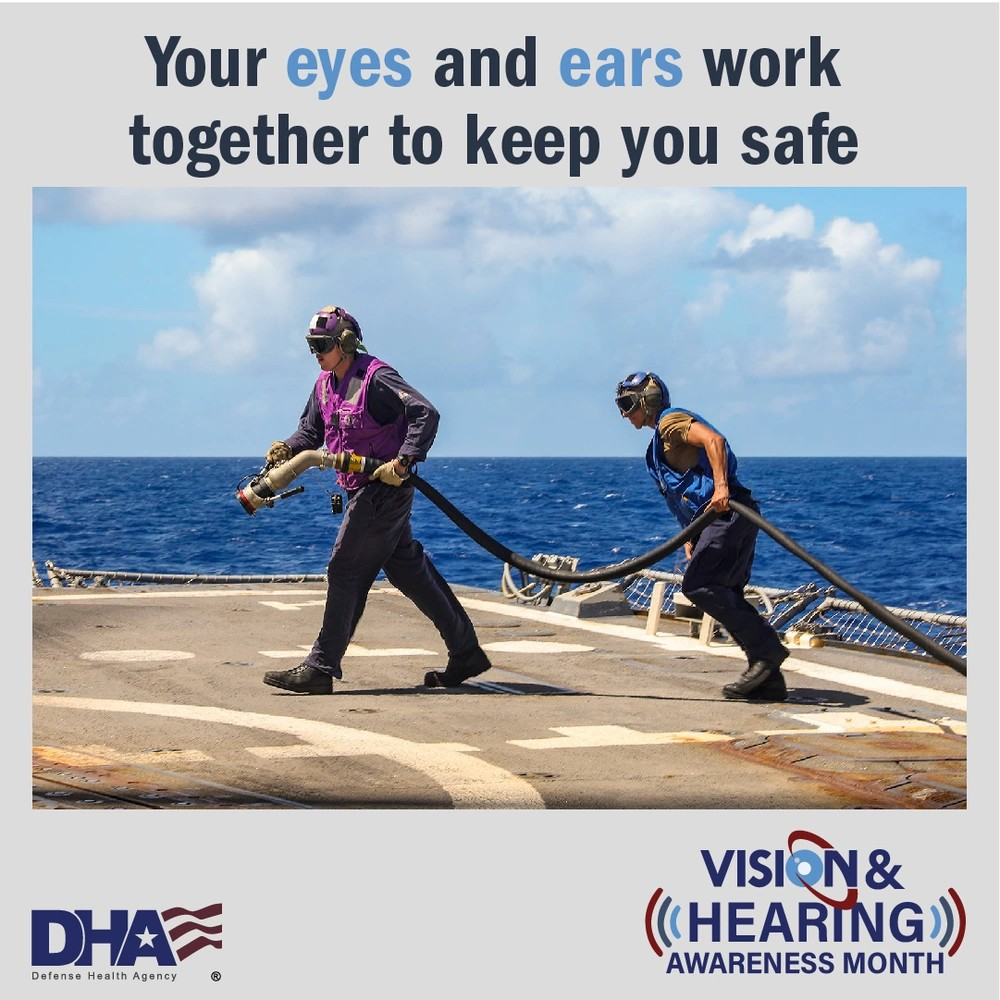 Vision – If you have VA health care benefits, we'll cover your routine eye exams and preventive vision testing (like testing for glaucoma). In some cases, you may get coverage for eyeglasses or services for blind or low-vision rehabilitation. VA covers the cost of eyeglasses if Veterans meet at least one of the requirements listed below:
- Have a Service-Connected disability, or
- Are a former Prisoner of War (POW), or
- Were awarded a Purple Heart, or
- Receive benefits under Title 38 United States Code (U.S.C.) 1151, or
- Receive an increased pension based on your being permanently housebound and in need of regular aid and attendance
If you’re a Veteran or active-duty Service member who is blind or has low vision, you may be able to get advanced vision care and rehabilitation Services through VA to help you live an independent life. VA works with non-VA agencies that provide guide or Service dogs. Many of these organizations don’t charge for the dog or the dog’s training. And if you’re eligible for a guide or Service dog, we’ll pay for the veterinary care and equipment (like a harness or backpack) that you’ll need for the dog to work at its best.
Hearing Aids – Veterans enrolled with VA Health Care may schedule an appointment at the Audiology and Speech Pathology Clinic for an evaluation of your hearing. To receive hearing aids through VA, you must first register at the health Administration/enrollment section of the VA Medical Center of your choice. In the military, selecting and wearing proper hearing protection can mean the difference between life and death. Likewise in a non-work environment, proper hearing protection increases your safety. If hearing aids are recommended and fit, the hearing aids, repairs, and future batteries will all be at no charge to you, as long as you maintain VA eligibility for care.
Veterans Dental – Former Prisoners of War (POW) and service-connected disabled Veterans rated 100% (total) disabling are eligible for VA Dental Care. VA provides dental care to qualified Veterans at over 200 dental clinics across the country, including Alaska and Puerto Rico. Veterans enrolled in the VA Health Care System may be eligible for VADIP. If you’re not eligible for VA dental care, VA Dental Insurance Program (VADIP) offers discounted private dental insurance for Veterans and family members who meet certain requirements. VADIP helps Veterans buy private dental insurance at a reduced cost through MetLife and Delta Dental. For more information about eligibility for VA dental benefits, contact VA at 1-877-222-8387. For questions about MetLife, call 1-888-310-1681. For questions about Delta Dental, call 1-855-370-3303.
 VA Vet Centers – Vet Centers in VISN 20 are community-based counseling centers that provide a wide range of social and psychological services, including professional readjustment counseling to eligible Veterans, active-duty Army, Navy, Marine Corp, Air Force, Coast Guard, and Space Force service members, including National Guard and Reserve components, and their families. Life isn't always easy after a deployment. That's where we can help. We offer confidential support for Veterans, service members, and their families at no cost in a relaxed, non-medical setting. Our services include counseling for needs such as depression, post traumatic stress disorder (PTSD), and the psychological effects of military sexual trauma (MST). We can also connect you with more support in VA and your community. Around the clock confidential call center for combat Veterans and their families at 1-877-WAR-VETS (1-877-927-8387) to talk about their military experience or any other issue they are facing in their readjustment to civilian life. The staff is comprised of combat Veterans from several eras as well as families members of combat Veterans. This benefit is prepaid through the Veteran’s military service.
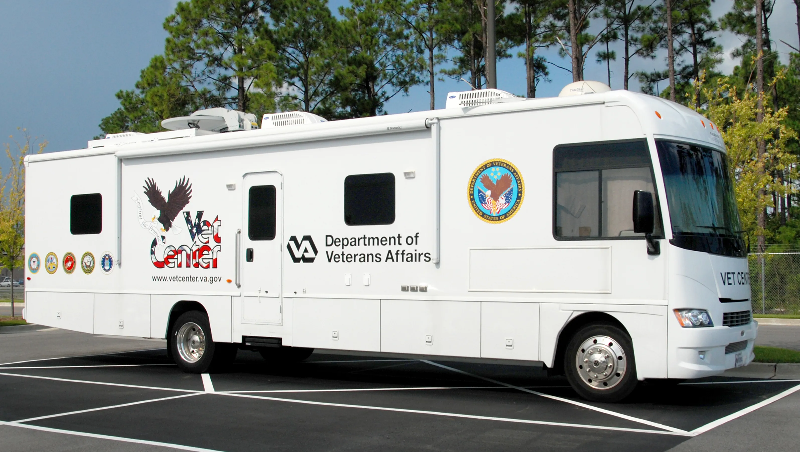 VA's 83 Mobile Vet Centers (MVC) are large mobile vehicles with space for confidential counseling and are used to provide outreach to eligible individuals in communities that are distant from existing services. The vehicles—closely resembling the RVs—provide Veterans with vital, on-the-spot treatment and resources. Veterans can receive counseling and information on VA benefits information. MVCs reduce travel time and expenses for Veterans. Instead of driving two hours for an appointment, Veterans now have the opportunity to meet with someone in their hometown. MVCs can access records through encrypted connection. With this capability, MVCs are often called upon to support VA in its important mission of providing emergency services in response to national emergencies and disasters. In Fiscal Year 2024, more than 110,000 Veterans, service members, and their families had more than 1.2 million encounters at VA's 300+ Vet Centers nationwide.
Fisher House Foundation – Are you in need of a home away from home? Fisher Houses provide military families housing close to a loved one in the hospital for an illness, disease or injury. Fisher House Foundation builds comfort homes where military & Veteran families can stay free of charge, while a loved one is in the hospital. These homes are located at military and VA medical centers around the world. Fisher Houses have up to 21 suites, with private bedrooms and baths. Families share a common kitchen, laundry facilities, a warm dining room, and an inviting living room. If you or someone you love is receiving care at a VA or military medical center, check the list of Current Houses to see if there is a Fisher House that can help. Criteria to stay is established locally by the hospital or installation command so please contact the location with any questions. There is never a charge to stay at a Fisher House.
Hotels for Heroes – There are times when a Fisher House is unavailable. The Hotels for Heroes program steps in when this happens and provides a hotel room for families eligible to stay in a Fisher House. If you believe you qualify for a hotel room, please contact your Service member’s case worker or Fisher House manager at the location of treatment.
 Hero Miles – Life doesn’t stop when a Service member is wounded, injured or becomes ill. The Hero Miles program enables these heroes and their loved ones to try and balance hospital life and home life. The Fisher House Foundation proudly partners with the following major airlines in support of our wounded, ill, and injured Service men and women and their families: Alaska Airlines, Delta Air Lines, Frontier Airlines, and United Airlines. Using frequent flyer miles, round trip airfare is purchased for;
Wounded, ill, and injured Service members on ordinary leave from the medical center to home or an authorized event Loved ones of wounded, ill, and injured Service members to visit the authorized medical center Loved ones to attend the Dignified Transfer of Remains at Dover Air Force Base
Veterans online shopping benefit – The Veterans online shopping benefit for the four military exchanges (Army Air Force Exchange, Navy Exchange Services Command, Marine Corps Exchange, and Coast Guard Exchange) became effective on Veterans Day in 2017. To qualify for participation in the Veterans online shopping benefit, you must be a Veteran of the United States Armed Forces with a discharge status of "honorable" or "general under honorable conditions." If you meet these requirements, please go to your favorite online exchange (Army/Air Force Exchange, Navy Exchange Services Command, Marine Corps Exchange, and Coast Guard Exchange) and try to register for an account. You will be redirected to VetVerify if more information needed. VetVerify.org is a shared service for the four military exchanges with the sole purpose of supporting the Veterans online shopping benefit. VetVerify uses data from the Defense Manpower Data Center (DMDC) as well as other government sources of Veteran records to verify eligibility.
Exchange Shopping Privileges for Veterans – The Defense Department announced expanded Military Service Exchange access effective 1 January 2020 as part of the Purple Heart and Disabled Veterans Equal Access Act of 2018, included in the John S. McCain National Defense Authorization Act for Fiscal Year 2019. Unless otherwise authorized commissary, exchange and MWR access, only veterans who are Purple Heart recipients, veterans who are former prisoners of war, or veterans who have a Department of Veterans Affairs documented service-connected disability rating between 0-90% are authorized in-person privileges as of Jan. 1, 2020, as provided for in Section 1065 of Title 10, United States Code. In accordance with Section 1065 of Title 10, U.S.C., the following veterans and care givers are authorized access to military exchanges:
- Veterans who were awarded the Purple Heart.
- Veterans who are former prisoners of war (POWs).
- Veterans classified by VA as having a service-connected disability rating below 100 percent.
- Caregivers or family caregivers who are enrolled as the primary caregiver for a veteran in the VA Program of Comprehensive Assistance for Family Caregivers. Caregivers are only eligible for these privileges during their period of active enrollment as the primary caregiver for a veteran.

Defense Commissary Agency (DeCA) – American military commissaries provide a military benefit of discounted groceries and household goods to active-duty, Reserve and Guard members of the uniformed Services, retirees of these Services, authorized family members, DOD civilian employees overseas and other designated categories. Commissaries constitute one of the top nonpay benefits for today’s military and are an important inducement to recruitment and retention of skilled personnel, while simultaneously holding down taxpayer costs. The Defense Department expanded Commissary access as part of the Purple Heart and Disabled Veterans Equal Access Act of 2018, included in the John S. McCain National Defense Authorization Act for Fiscal Year 2019. Access was expanded to include:
Veterans with any service-connected disability Purple Heart recipients Former Prisoners of war, and Individuals approved and designated as the primary family caregivers of eligible Veterans under the VA Program of Comprehensive Assistance for Family Caregivers
What you need to do before you shop.
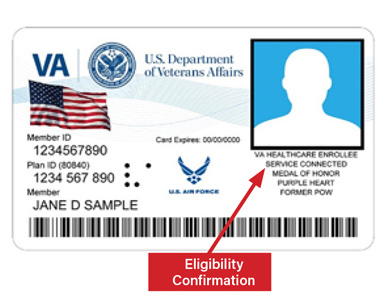 Confirm your Veteran Health Identification Card (VHIC) has one of the required designations, (SERVICE CONNECTED, MEDAL OF HONOR, PURPLE HEART, FORMER POW), or obtain your Veteran Health Identification Card (VHIC) as outlined above. You will need this for your commissary checkout experience.
- Contact the base you intend to visit beforehand and determine what their current policy is for base access.
- Check out https://shop.commissaries.com/store-flyer to start saving now or https://shop.commissaries.com to place your order online.
Commissary Store Locations in VISN 20 are located in Alaska, Idaho and Washington. DeCA has no authority to determine whether a person is authorized to shop in the commissary. If you believe you may be entitled to commissary privileges, visit your local installation Pass and ID office for information about military benefits and to obtain an ID card consistent with your entitlements. To obtain a VHIC, you’ll need to be enrolled in VA health care. If you’re not already enrolled, you can contact your nearest VA medical center and ask to speak with the enrollment coordinator. T
While not all veterans are eligible for in-person privileges on DoD and Coast Guard installations, all honorably discharged Veterans are eligible for online military exchange shopping through the Veterans Online Shopping Benefit for the four military exchanges (Army Air Force Exchange, Navy Exchange Services Command, Marine Corps Exchange, and Coast Guard Exchange). This lifelong benefit became effective on Veterans Day in 2017 and allows honorably discharged Veterans of all United States Armed Forces to shop online at any and all of the exchanges. The online exchanges serves honorably discharged Veterans of all United States Armed Forces. VetVerify is a shared verification service of the four military exchanges (Army Air Force Exchange, Navy Exchange Services Command, Marine Corps Exchange, and Coast Guard Exchange) that supports the Veterans online shopping benefit by verifying Veterans who cannot be authenticated by the exchanges alone.
Education and Employment Initiatives (E2I) and Operation War Fighter (OWF) – E2I is available to all wounded, ill, and injured Service members in all branches of the military services, as well as all components of those services – Active, Guard and Reserve. Operation Warfighter (OWF) is a DoD internship program that matches qualified wounded, ill, and injuredService members with non-funded federal internships in order for them to gain valuable work experience during their recovery and rehabilitation.
 VA extends presumptive period for Persian Gulf War Veterans – VA has extended the presumptive period to Dec. 31, 2026 for qualifying chronic disabilities rated 10% or more resulting from undiagnosed illnesses in Persian Gulf War Veterans. Persian Gulf War operational names included Desert Shield, Desert Storm, Desert Sabre, Southern Watch, Provide Comfort, and Northern Watch. In addition, various phases of each operation may have a unique operational name. VA's Persian Gulf War Registry Health Exam alerts Veterans to possible long-term health problems that may be related to environmental exposures during military service. For VA benefit purposes, Gulf War service is active military duty in any of the Southwest Asia theater of military operations at any time August 2, 1990 to present. Wartime compensation for service-connected disability or death occurring in Persian Gulf War Veterans passed into law in 1994. Persian Gulf Veterans served on active duty in the Armed Forces in the Southwest Asia theater of operations during the Persian Gulf War.
- Iraq
- Kuwait
- Saudi Arabia
- The neutral zone between Iraq and Saudi Arabia
- Bahrain
- Qatar
- The United Arab Emirates (U.A.E.)
- Oman
- Gulf of Aden
- Gulf of Oman
- Waters of the Persian Gulf, Arabian Sea, and the Red Sea
- The airspace above these locations
VA automatically assumes service connection for the medical condition and provides appropriate benefits. Additionally, when a Veteran’s health condition is recognized as service-connected, they have access to free health care for that condition.
NW MIRECC disseminates mission-relevant knowledge through publications and continuing health care education programs across VISN 20 and nationally. Sign up for email updates or access your subscriber preferences: https://public.govdelivery.com/accounts/USVHAVISN20/subscriber/new.
Use of these Materials and Finding VA Health Care
Please note that the health care information provided in these materials is for educational purposes only. It does not replace the role of a medical practitioner for advice on care and treatment. If you are looking for professional medical care, find your local VA healthcare center by using the VA Facilities Locator & Directory. This page may contain links that will take you outside of the Department of Veterans Affairs website. VA does not endorse and is not responsible for the content of the linked websites.
VA Web Disclaimers
Disclaimer of Endorsement: Reference herein to any specific commercial products, process, or Service by trade name, trademark, manufacturer, or otherwise, does not necessarily constitute or imply its endorsement, recommendation, or favoring by the United States Government. The views and opinions of authors expressed herein do not necessarily state or reflect those of the United States Government, and shall not be used for advertising or product endorsement purposes.
Disclaimer of Hyperlinks: The appearance of external hyperlinks does not constitute endorsement by the Department of Veterans Affairs of the linked websites, or the information, products or Services contained therein. For other than authorized VA activities, the Department does not exercise any editorial control over the information you may find at these locations. All links are provided with the intent of meeting the mission of the Department and the VA website. Please let us know about existing external links which you believe are inappropriate and about specific additional external links which you believe ought to be included.
Disclaimer of Liability: With respect to documents available from this server, neither the United States Government nor any of its employees, makes any warranty, express or implied, including the warranties of merchantability and fitness for a particular purpose, or assumes any legal liability or responsibility for the accuracy, completeness, or usefulness of any information, apparatus, product, or process disclosed, or represents that its use would not infringe privately owned rights.
Reference from this web page or from any of the information Services sponsored by the VA to any non-governmental entity, product, Service or information does not constitute an endorsement or recommendation by the VA or any of its employees. We are not responsible for the content of any "off-site" web pages referenced from this server.
Disclaimer: The sharing of any non-VA information does not constitute an endorsement of products or Services on the part of the VA.

VA Regional Offices
The Veterans Benefits Administration (VBA) helps service members transition out of military service, and assists with Veterans with education, home loans, life insurance and much more. Service members, Veterans, their families, and Survivors are invited to request information on VA Benefits including disability compensation, pension, fiduciary, education, Veteran Readiness and Employment (VR&E), Home Loans, and Insurance. In addition to information on VA Benefits Veterans may initiate an intent to file and request assistance with filing compensation and pension claims. Visit regional office websites to learn about the services the regional office provides, directions to the facility, hours of operation, and the leadership team that serves the regional office.
Find out if you can get VA health care as a Veteran
The following four categories of Veterans are not required to enroll but are urged to do so to permit better planning of health resources:
- Veterans with a service-connected (SC) disability rated at 50% or more.
- Veterans seeking care for a disability the military determined was incurred or aggravated in the line of duty, but which VA has not yet rated, within 12 months of discharge.
- Veterans seeking care for a SC disability only or under a special treatment authority.
- Veterans seeking health registry examinations. VA’s health registry evaluation is a free, voluntary medical assessment for Veterans who may have been exposed to certain environmental hazards during military service. The evaluations alert Veterans to possible long-term health problems that may be related to exposure to specific environmental hazards during their military service. VA has established several health registries to track and monitor the health of specific groups of Veterans. You may be eligible to participate in one or more of these health registries: Agent Orange Registry, Airborne Hazards and Open Burn Pit Registry, Gulf War Registry (includes Operations Iraqi Freedom and New Dawn), Ionizing Radiation Registry, Depleted Uranium Follow-Up Program, and Toxic Embedded Fragment Surveillance Center. Use the chart below to help determine your eligibility.
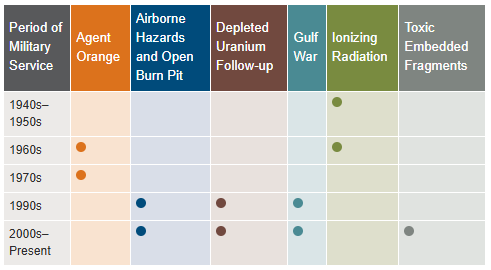
Find out how to apply for VA health care benefits as a Veteran or service member. For other mental health services, contact a VA medical center for information on eligibility and treatment options.
Community Care (Mission Act)
The MISSION Act became law in 2018, bringing the VA’s previous Veterans Choice Program to an end and establishing the Community Care Program. VA provides health care for Veterans from providers in your local community outside of VA. Veterans may be eligible to receive care from a community provider when VA cannot provide the care needed. This care is provided on behalf of and paid for by VA. Community care is also available to Veterans based on certain conditions and eligibility requirements, and in consideration of a Veteran’s specific needs and circumstances. VA offers urgent care services to eligible Veterans at in-network urgent care clinics to treat minor injuries and illnesses that are not life-threatening, such as colds, strep throat, sprained muscles, and skin and ear infections. Community care must be first authorized by VA before a Veteran can receive care from a community provider.
Vet Centers in VISN 20
 Vet Centers in VISN 20 are community-based counseling centers that provide a wide range of social and psychological services, including professional readjustment counseling to eligible Veterans, active-duty Army, Navy, Marine Corp, Air Force, Space Force, and Coast Guard service members, including National Guard and Reserve components, and their families. 1-877-927-8387 is an around the clock confidential call center where combat Veterans and their families can call to talk about their military experience or any other issue they are facing in their readjustment to civilian life. The staff is comprised of combat Veterans from several eras as well as families members of combat Veterans. This benefit is prepaid through the Veteran’s military service.
Alaska
| Anchorage Vet Center (Anchorage, AK) | Fairbanks Vet Center (Fairbanks, AK) |
| Kenai Vet Center Outstation (Soldotna, AK) | Wasilla Vet Center (Wasilla, AK) |
Idaho
| Boise Vet Center (Boise, ID) | East Idaho Vet Center (Idaho Falls, ID) |
Oregon
| Central Oregon Vet Center (Bend, OR) | Eugene Vet Center (Eugene, OR) |
| Grants Pass Vet Center (Grants Pass, OR) | Portland, OR Vet Center (Portland, OR) |
| Salem Vet Center (Salem, OR) |
Washington
Plan your trip to VA
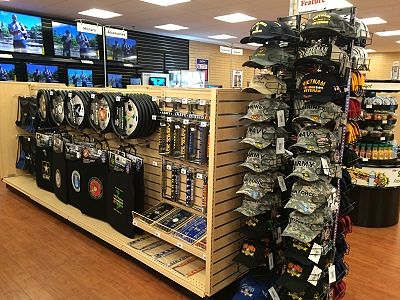 In 1946, Veterans Canteen Service (VCS) was established by law to provide comfort and well-being to America’s Veterans. With our many retail stores, cafés and coffee shops across the country, we serve those who have served our country. We are a self-sustaining entity providing merchandise and services to Veterans enrolled in VA’s healthcare system, their families, caregivers, VA employees, volunteers and visitors. We are honored to give back to the VA community through many programs established for the health and well-being of our nation’s heroes. Revenues generated from VCS are used to support a variety of programs, such as VA’s Rehabilitation Games, Fisher Houses, Poly-Trauma Centers for OIF/OEF/OND Veterans, disaster relief efforts, Substance Abuse Cessation, VA’s Homelessness initiatives, Women Veterans, Veteran Suicide Prevention and other activities.
VCS operates over 200 Patriot Stores in Veterans Administration (VA) Medical Centers nationwide. Many of our stores have been recently updated and expanded to provide our customers with a modern, clean and comfortable shopping experience. Our stores welcome our customers with wider aisles, wood-like floors, enhanced lighting and directional signage. PatriotStores have expanded hours of operation to provide service for customers on weekends at most locations.
The Patriot Cafe is the best place in the VA Medical Center to enjoy delicious, freshly prepared breakfast or lunch served hot or cold each weekday. Providing Veterans, their families, VA employees, volunteers and visitors a place to relax and enjoy a meal or take-out for their convenience. With a wide variety of food from traditional comfort food, specialized menu selections and a large assortment of healthy choices; there is something for everyone's taste buds.
Hospital Service Directory
To find out whether there is a van near you use the Disabled American Veterans (DAV) Hospital Service Coordinator Directory to contact your nearest HSC for information or assistance. Please remember that the DAV Transportation Network is staffed by volunteers; therefore, it is unable to cover every community. The vans are driven by volunteers, and the rides coordinated by more than 133 Hospital Service Coordinators around the country. Our nation’s heroes travel around the globe to protect our freedoms—it’s only right that we return their dedication. Volunteering to drive a Vet ensures that even those living remotely from VA hospitals can make their appointments and never go without the treatment they need. Learn more about the DAV transportation network through the VISN 20 NewsFlash Resources section.
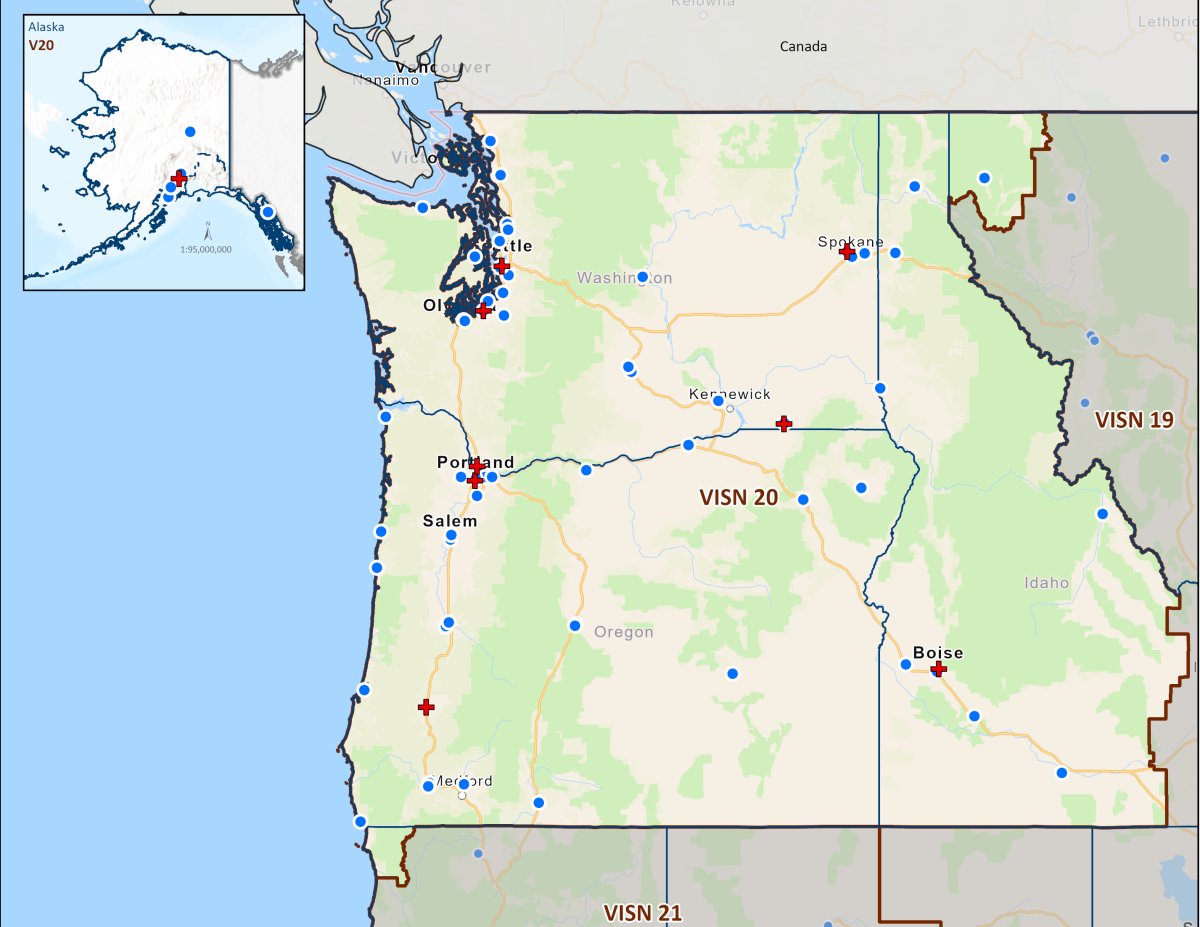 Today's VHA - the largest of the three administrations that comprise the VA - continues to meet Veterans' changing medical, surgical, and quality-of-life needs. VHA is the largest integrated health care system in the United States, providing care at 1,321 health care facilities, including 172 VA Medical Centers and 1,138 outpatient sites of care of varying complexity (VHA outpatient clinics) to over 9 million Veterans enrolled in the VA health care program. There are 18 Veterans Integrated Service Networks (VISNs) in VHA operating as regional systems of care to better meet local health care needs and provides greater access to care. In the Pacific Northwest, VISN 20 serves Veterans in Alaska, Oregon, Washington, most of Idaho, and one county each in California and Montana. Spanning 23% of the US land mass, VISN 20 is the largest geographic region of VA. Operating across three time zones over 817,417 square miles, VISN 20 is home to 273 federally recognized American Indian and Alaskan Native tribes. According to DoD, American Indians and Alaska Natives have one of the highest representations in the United States Armed Forces. VA consults with American Indian and Alaska Native tribal governments to develop partnerships that enhance access to services and benefits by Veterans and their families. VA is committed to ensuring that Native American Veterans and their families are able to utilize all benefits and services they are entitled to receive. As of the end of FY2024, 39% of VISN 20 enrollees resided in rural or highly rural areas.
VA Medical Centers within VISN 20
Colonel Mary Louise Rasmuson Campus of the Alaska VA Healthcare System, Anchorage, Alaska
VA Boise Medical Center of the Boise VA Healthcare System, Boise, Idaho
VA Portland Medical Center of the Portland VA Healthcare System, Portland, Oregon
VA Roseburg Medical Center of the Roseburg VA Healthcare System, Roseburg, Oregon
VA White City Medical Center of the VA Southern Oregon Healthcare System, White City, Oregon
VA Seattle Medical Center of the VA Puget Sound Healthcare System, Seattle, Washington
Mann-Grandstaff Department of Veterans Affairs Medical Center, Spokane, Washington
Jonathan M. Wainwright Memorial VA Medical Center of the VA Walla Walla Healthcare System, Walla Walla, Washington
VA Puget Sound Health Care System (VAPSHCS) serves Veterans from a five-state area in the Pacific Northwest with two main divisions: American Lake VA Medical Center and Seattle VA Medical Center. Veterans Medical Centers are also located in Spokane, Vancouver, and Walla Walla. VA Outpatient Clinics and Vet Centers are located in Bellingham, Bellevue, Bremerton, Edmunds, Everett, Federal Way, Lacey, Mount Vernon, Olympia, Port Angeles, Puyallup, Richland, Renton, Silverdale, Seattle, Spokane, Union Gap, Vancouver, Walla Walla, Wenatchee, and Yakima.
VA Portland Health Care System (VAPORHCS) serves Veterans in Oregon and Southwest Washington with two main divisions: Portland VA Medical Center and Vancouver VA Medical Center. Veterans Medical Centers are also located in Roseburg, White City, and Vancouver, Washington. VA Outpatient Clinics and Vet Centers are located in Astoria, Bend, Boardman, Brookings, Eugene, Fairview, Grants Pass, Hines, Hillsboro, Klamath Falls, LaGrande, Lincoln City, Newport, Portland, Salem, The Dalles, and West Linn.
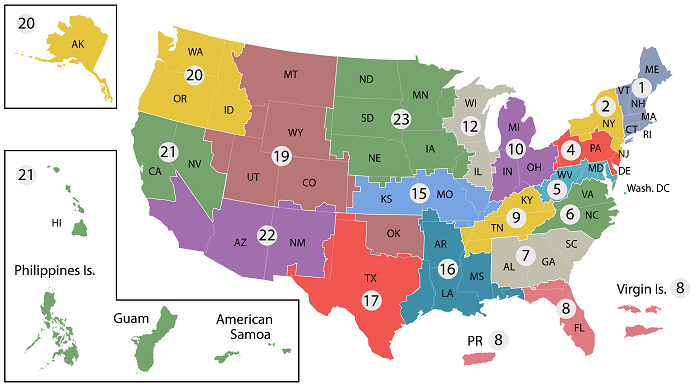
- VISN 1: VA New England Healthcare System
- VISN 2: New York/New Jersey VA Health Care Network
- VISN 4: VA Healthcare - VISN 4
- VISN 5: VA Capitol Health Care Network
- VISN 6: VA Mid-Atlantic Health Care Network
- VISN 7: VA Southeast Network
- VISN 8: VA Sunshine Healthcare Network
- VISN 9: VA MidSouth Healthcare Network
- VISN 10: VA Healthcare System
- VISN 12: VA Great Lakes Health Care System
- VISN 15: VA Heartland Network
- VISN 16: South Central VA Health Care Network
- VISN 17: VA Heart of Texas Health Care Network
- VISN 19: Rocky Mountain Network
- VISN 20: Northwest Network
- VISN 21: Sierra Pacific Network
- VISN 22: Desert Pacific Healthcare Network
- VISN 23: VA Midwest Health Care Network